
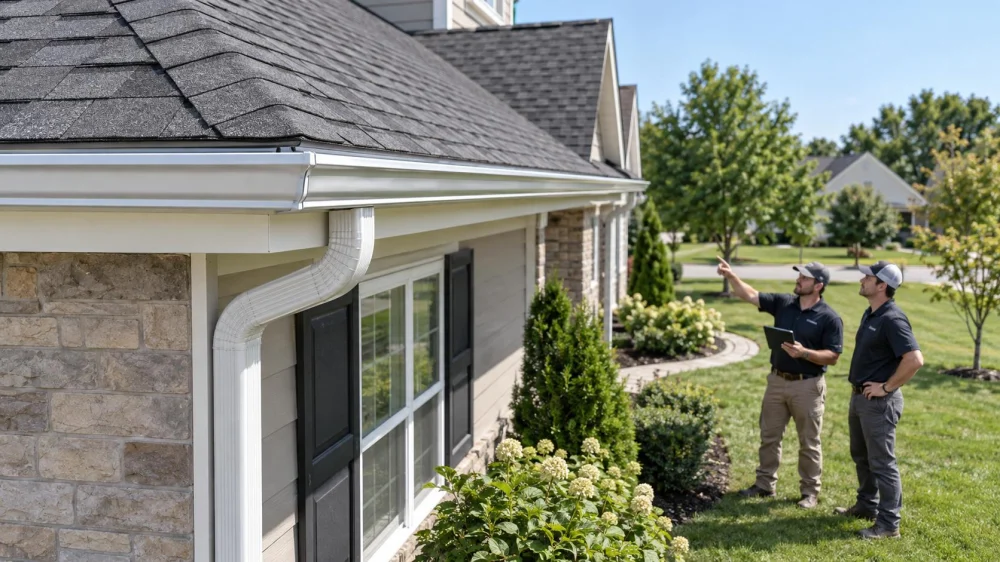
Gutters During Roof Repair: Protect, Refit, and Test
On this page
Quick answer
Include gutters in the roof-repair plan before work starts. Photograph their condition, identify sections that must be protected or removed, assign responsibility for hangers, guards, downspouts, and cleanup, then inspect alignment and discharge after refitting. Use a ground-level or contractor-run water check; do not climb to diagnose leaks or loose edges.

Ab-Tec roofing & Home Improvement
DracutMiddlesex CountyMassachusetts
48 Stone St, Dracut, MA 01826, USA
Why gutters belong in the roof scope
Gutters collect runoff at the roof edge and route it through downspouts to an appropriate discharge point. Roof repairs near eaves, fascia, drip edge, underlayment, or decking can affect gutter access and alignment even when the gutter itself is not being replaced.
A crew may need to protect, loosen, remove, or work above sections of the system. Heavy materials, ladders, debris, and foot traffic can dent components or move hangers. Clear responsibility prevents a gap between the roofer, gutter contractor, and homeowner.
New Look Masonry & Construction
SomervilleMiddlesex CountyMassachusetts
240 Elm St 2nd & 3rd floor, Somerville, MA 02144, USA
Document conditions before work
- Photograph each elevation from the ground, including corners, outlets, seams, guards, and downspouts.
- Note existing dents, staining, sagging, loose sections, overflow marks, or damaged fascia.
- Record where downspouts discharge and whether extensions must be moved.
- Identify underground drain connections that should not receive roofing debris.
- Ask whether leaf guards, heat cables, rain barrels, or decorative components affect access.
Do not reach from a window or climb a ladder solely for documentation. A contractor can capture close views when safe access is established.
Define protection and removal
The written scope should state which sections stay, which are removed, who stores them, how openings are protected, and who reinstalls or replaces damaged components. Include guards, brackets, straps, outlets, downspout elbows, extensions, and fasteners rather than using the single word “gutters.”
Ask how debris will be kept out of outlets and underground drains, how ladders will avoid crushing the system, and how new drip edge or roof-edge components will interface with the gutter. Confirm whether fascia damage or hidden rot triggers a separate approval.
Inspect the refit
- From the ground, look for consistent alignment, secure corners, connected downspouts, and open outlets.
- Compare the finished system with before-work photos.
- Check that guards and extensions are present and that fasteners or scraps are removed.
- Look for gaps at the roof edge, new dents, twisted sections, or discharge aimed at the foundation or walkway.
- Record concerns before final sign-off and ask the responsible contractor to inspect them.
Appearance alone cannot confirm slope, fastening, hidden seams, or correct roof-edge integration. Ask the contractor to document those details and explain any change to the original layout.
Verify drainage safely
A controlled water check can confirm that flow reaches outlets and downspouts without obvious leakage or backup. It should be performed by the contractor using safe access and an appropriate water volume, or observed from the ground during ordinary rain.
Watch discharge points, seams, corners, fascia, and the ground near the foundation. Stop the test if water enters the building, backs up, or creates an unsafe surface. A brief hose test cannot reproduce every storm or prove that concealed components are sound.
Important limits
This guide provides general U.S. homeowner planning, not a gutter design or roof specification. Roof pitch, rainfall, drainage area, snow, codes, manufacturer instructions, and site grading affect the right system. Qualified contractors should assess elevated and concealed conditions.
Keep ladders and roof edges to trained workers using appropriate fall protection. Water near electrical equipment, damaged structures, or icy surfaces requires additional controls.
Frequently asked questions
Must gutters always be removed for roof repair?
No. The repair location and roof-edge details determine access. The contractor should explain whether protection, loosening, or removal is needed.
Who pays if a gutter is damaged?
Responsibility depends on the contract, existing condition, and cause. Document before work and define responsibility in writing.
Can new drip edge change gutter position?
It can affect roof-edge integration. Ask how the components will overlap and whether hangers or spacing must change.
Should underground drains be tested too?
If downspouts connect to them, include the connection in planning. A drainage specialist may be needed for a suspected underground blockage.
Sources and evidence notes
This checklist follows common construction coordination principles: document existing conditions, assign interfaces, protect adjacent systems, inspect reinstatement, and test performance. The roof and gutter manufacturers' instructions and local requirements control specific details.
Next steps
Add the gutter system to the written roof scope, take ground-level photos, and name the contractor responsible for removal, storage, refitting, and drainage checks. Before final payment, compare conditions, confirm downspout discharge, and resolve new damage or misalignment.




 Ab-Tec roofing & Home Improvement4.0 (33 reviews)
 New Look Masonry & Construction0.0 (0 reviews)
 Owens Corning Certified Roofing Installations0.0 (0 reviews)
 Somerville Roofing Solutions3.0 (9 reviews)
 Castle slate roofing co.4.0 (13 reviews)
 FRS Roofing + Gutters - Watertown Roofing0.0 (0 reviews)
 Gutters During Roof Repair: Protect, Refit, and Test
 Temporary Roof Cover: Scope, Checks, and Safe Removal
 Roof Repair With Solar Panels: Assign Every Responsibility
 Roof Repair Pet Plan: Noise, Gates, and Safe Rooms
 Roof Completion Check: Test, Photograph, and File Records
 Roof Maintenance Reminder: Use Condition and Instructions