
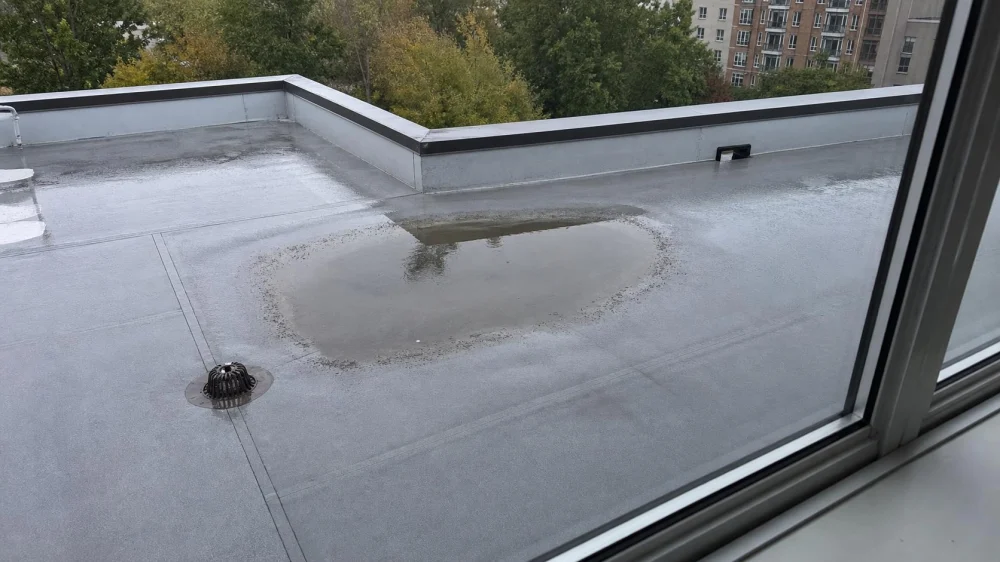
Ponding Water on a Low-Slope Roof: What to Check
On this page
Quick answer
Water that remains in the same low-slope roof area long after rain may indicate a blocked drain, settled insulation, deck deflection or inadequate slope. Do not walk onto the wet roof or add drainage holes. Photograph the area from a safe elevated interior viewpoint or ground-accessible angle, note rainfall and drying time, check indoors for leaks, and have a qualified roofer assess drainage, membrane seams and structural support.
What ponding water means
Ponding water is water that remains in a roof depression rather than draining or evaporating within the time expected by the roof system's design and manufacturer. There is no single universal hour threshold for every membrane, climate and warranty.
Low-slope roofs are designed with drainage paths, but small temporary wet areas immediately after rain may not indicate failure. Repeated water at the same location, deepening pools, vegetation, sediment rings or slow drying deserve assessment.
Great Group Roofing And Chimney
Cliffside ParkBergen CountyNew Jersey
231 Columbus Pl, Cliffside Park, NJ 07010, USA
Safe observation checklist
- Stay off wet, icy or unfamiliar roof surfaces.
- Photograph from a safe window, neighbouring elevation or ground position using zoom.
- Record rain end time, approximate depth clues and when the area clears.
- Map the pond relative to drains, scuppers, seams, equipment and walls.
- Check visible outlets and downspouts from the ground for discharge or overflow.
- Inspect ceilings and accessible interior spaces below for stains, drips, odour or sagging.
- Compare dated images after several storms.
Best homeowner task: documentation and interior observation. Not suitable for DIY: roof walking, opening drains from above, cutting membrane or placing heavy pumps and hoses.
Likely causes
- Blocked drainage: leaves, sediment, ice or displaced components restrict drains and scuppers.
- Improper slope: design or installation may not direct water continuously to outlets.
- Compressed or settled insulation: traffic, moisture or construction can create a depression.
- Deck deflection: structural movement may form a low point and requires qualified evaluation.
- Added equipment: curbs, conduits or repairs can interrupt drainage paths.
- Membrane buildup: repeated patching may create dams around the original problem.
- Discharge problem: clogged downspouts or frozen outlets can back water onto the roof.
The visible pond does not identify the cause. A contractor should evaluate both the low point and the intended drainage route.
Why repeated ponding matters
- Added water weight increases load on the deck and framing.
- Standing water can accelerate aging of some roof materials.
- Seams, flashings and small defects remain submerged longer.
- Sediment and biological growth can further obstruct drainage.
- Freeze-thaw cycles can stress details in cold climates.
- Moisture may enter insulation and reduce performance before an indoor drip appears.
Keep people away from an area below visible ceiling sagging, active electrical leakage or unusual structural noise. Contact emergency and qualified building professionals for immediate danger.
Repair and drainage decisions
Depending on findings, work may include clearing and protecting drains, correcting a downspout, rebuilding tapered insulation, adding a code-compliant drain or scupper, repairing wet substrate, replacing membrane sections or addressing structural deflection.
Surface coating alone does not create slope. Adding a drain without analyzing discharge, overflow, structure and code can move the problem elsewhere. The repair should coordinate primary drainage and emergency overflow provisions.
Questions for a roofing contractor
- Where is the designed high point, low point and outlet?
- Is the pond caused by blockage, insulation, deck movement or layout?
- Were membrane seams and flashings probed or otherwise assessed appropriately?
- Is moisture present below the membrane or in insulation?
- Does the structure need engineering review?
- How will slope be verified after repair?
- Are overflow drainage and discharge paths adequate?
- What manufacturer and warranty requirements apply?
Verify locally applicable licensing, insurance and written scope. Compare contractors by documented cause and drainage plan, not only patch area.
Important notes and evidence boundaries
This guide reflects general U.S. low-slope roofing and drainage practice. Codes, rainfall design, snow loads, membrane details and manufacturer definitions vary. It is not an engineering calculation or warranty interpretation.
Never intentionally puncture a roof to release water. Do not direct pumped water onto pedestrians, neighbouring property, foundations or an overloaded drainage system.
Frequently asked questions
Is any water on a flat roof a defect?
Not necessarily. “Flat” roofs have low slope, and temporary wetting after rain can occur. Repeated persistent ponds require context-specific assessment.
Can I sweep water toward the drain?
Roof access and wet surfaces are hazardous, and sweeping can damage materials. Use qualified maintenance personnel.
Will roof coating fix ponding?
A coating may protect compatible surfaces but does not usually correct slope, deck movement or blocked drainage.
Does ponding always cause a leak?
No, but it can increase exposure time and reveal vulnerable seams or flashings. Hidden moisture may exist without an active drip.
Who should inspect structural deflection?
A roofer can document the roof condition; a qualified structural professional may be needed when the deck or framing appears to move or sag.
Next steps
Document the pond after rain without roof access, note drainage timing and check below for moisture signs. Request an inspection covering outlets, slope, membrane, insulation and deck. Choose a repair that corrects the water path and verifies dry, sound support.

 MANNY BEST CONTRACTOR CORP4.0 (8 reviews)
 Erie Home4.0 (224 reviews)
 JCJ Services LLC5.0 (5 reviews)
 Total Roofing5.0 (43 reviews)
 Harbor Roofing and Contracting, Inc.3.0 (17 reviews)
 Windows, Siding and Roofing in Old Bridge4.0 (2 reviews)
 How to Identify and Repair Roof Damage from Air Pollution
 How to Prevent Roof Damage from Inadequate Fireproofing in High-Risk Areas
 The Lifespan of a Roof in a Hurricane-Prone Area: Key Factors and Tips
 How to Soundproof a Metal Roof to Reduce Rain Noise
 How to Choose a Roofing Contractor That Uses OSHA Safety Standards
 How to Remove Snow from a Metal Roof Without Causing Damage