
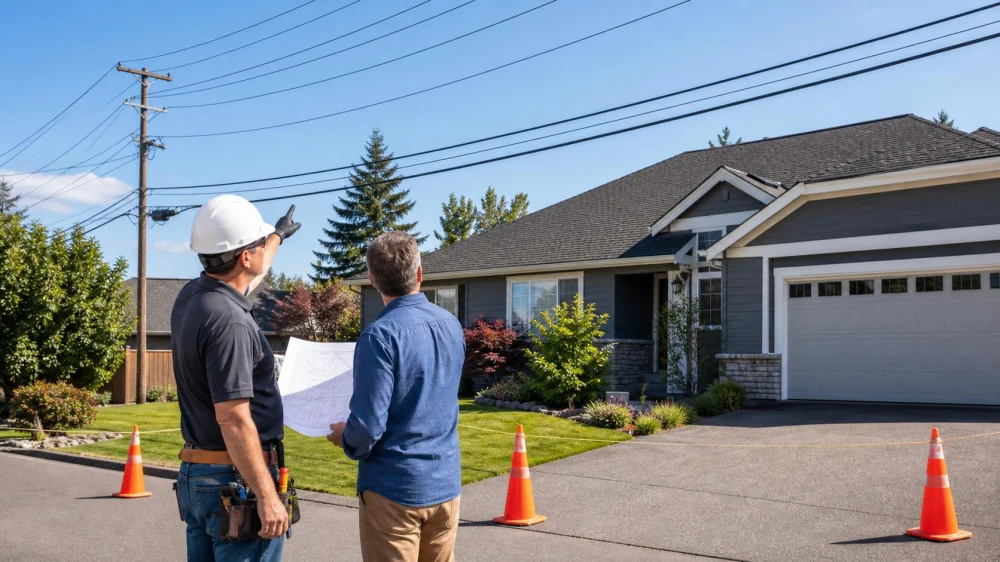
Roof Work Near Power Lines: A Homeowner Safety Plan
On this page
Quick answer
Before roof work begins, identify overhead lines, service drops, rooftop electrical equipment, buried-service indicators, and access routes from the ground. Tell the roofing contractor about every visible line and ask for its written electrical-hazard plan. The contractor and utility—not the homeowner—should determine clearances, de-energizing, grounding, guarding, equipment choice, and qualified work. Treat every line as energized until the operating utility confirms otherwise.
This guide is for U.S. homeowners planning roof repair or replacement. Electrical safety rules depend on voltage, employer, task, equipment, jurisdiction, and utility control; do not calculate a safe approach distance yourself.
Why roof projects create electrical exposure
Roofing places people, ladders, long materials, metal edges, hoists, scaffolds, dump trucks, and tools above ground. An object does not always need to touch a high-voltage line for a dangerous event to occur. Wind, loss of balance, equipment movement, and material flex can close a planned gap quickly.
Residential service wires may appear insulated, but appearance does not establish protection or voltage. Cable, telephone, and power lines can also be confused. Only the organization that operates the circuit can confirm its status and control de-energizing or grounding.
Electrical exposure is not limited to the roof edge. Extension cords, damaged tools, temporary power, generators, solar equipment, rooftop HVAC, antennas, metal gutters, and interior wiring can add hazards.
Green Apple Roofing
EdisonMiddlesex CountyNew Jersey
1000 New Durham Rd suite 1223, Edison, NJ 08817, USA
Identify hazards from a safe location
- Walk the property from ground level without approaching or touching wires, poles, masts, trees in lines, or electrical equipment.
- Note lines near proposed ladder, scaffold, hoist, crane, dumpster, and material-delivery locations.
- Photograph wide context from a safe public or property position; do not use a pole, drone, ladder, or rooftop viewpoint near lines.
- Mark known rooftop solar, service mast, weatherhead, antenna, satellite, HVAC, and concealed electrical work on the project briefing.
- Tell the contractor about any previous flickering, damaged service attachment, sparking, heat, storm damage, or utility notice.
Do not trim branches near electrical lines, move a line with a board or rope, cover it with household material, or assume shutting off the home's main breaker de-energizes the utility service conductors.
Questions for the roofing contractor
- Who completed the electrical-hazard assessment for this project?
- Which overhead, service, rooftop, and temporary-power hazards were identified?
- How will ladders, long metal materials, delivery vehicles, hoists, scaffolds, and debris stay within required controls?
- Does the operating utility need to de-energize, ground, relocate, guard, or otherwise support the work?
- Who will communicate with the utility, and what written confirmation is required before start?
- Which tasks require qualified electrical workers or another trade?
- How will workers and subcontractors be briefed and the restricted area marked?
- What weather or site change will stop work and trigger reassessment?
A contractor should be able to explain responsibility and process without asking the homeowner to hold a ladder, watch a clearance, or move electrical equipment.
Coordinate with the utility
Contact the utility through its official number when the contractor or project conditions indicate coordination is needed. Provide the service address, project scope, planned dates, contractor contact, and location of lines.
Ask what lead time, site visit, forms, fees, access, outage notice, and restoration steps apply. Record the work-order number and instructions. A scheduled outage is not effective until the utility completes and confirms the action specified for the project.
Do not authorize work based on a homeowner's voltage guess or an online map. If a line belongs to a communications company or another owner, the responsible operator should still be identified through proper channels.
Workday homeowner checklist
- Keep children, pets, visitors, and vehicles outside the work and utility-control areas.
- Do not move barricades, ladders, cords, equipment, or delivered materials.
- Keep windows and doors near restricted zones closed as planned.
- Tell the site lead immediately about a new line condition, storm damage, fallen branch, or unexpected utility worker.
- Do not retrieve debris near a line or touch metal gutters, downspouts, fences, or equipment after suspected contact.
- Respect stop-work decisions and utility restoration checks.
Review the hazard plan again when the scope changes, a lift or crane arrives, scaffolding moves, a new delivery route is used, or weather affects control of long materials.
Emergency actions and limitations
If equipment, a ladder, material, tree, or person contacts a power line, stay far away and call 911 and the utility. Do not touch the person, vehicle, equipment, wire, nearby fence, or material; the ground around the contact may be energized. Warn others away without entering the area.
A fallen line is an emergency even when it is quiet, not sparking, or appears insulated. Do not approach it to take a photo or move debris.
This article cannot set an approach distance, choose insulation, approve a ladder, or establish that a circuit is de-energized. Those decisions require applicable regulations, qualified personnel, and the utility or circuit owner.
Frequently asked questions
Can the home's main breaker make roof service wires safe?
Do not assume so. Utility-side conductors may remain energized. Only the operating organization and qualified professionals can establish the required safe condition.
Are black-coated overhead wires insulated?
Appearance does not prove safe insulation or voltage. Treat them as energized and keep away while the contractor and utility identify the line.
Can a roofer use a fiberglass ladder near a line?
Ladder material alone does not make the work safe. Required clearance, placement, condition, contamination, task, and electrical controls still apply.
Who calls the utility?
Put responsibility in the project plan. The contractor often coordinates work hazards, while the account holder may need to authorize access or an outage. Confirm roles with both parties.
Should roof work continue after a storm moves a line?
No one should assume the original plan still works. Stop, keep away, contact the utility, and have the contractor reassess before work resumes.
Sources and evidence notes
This checklist follows the principle that overhead lines should be treated as energized and that protective measures must be established before nearby work. The Occupational Safety and Health Administration's guidance for work near overhead power lines emphasizes planning and utility coordination. OSHA's roof electrical-hazard page adds construction-tool, cord, GFCI, ladder, and line-awareness context. Employers must apply the rules governing their actual work.
Next steps
From the ground, list every line and electrical feature near access, delivery, and roof work. Send the list to the contractor and ask who owns the hazard assessment and utility contact. Do not allow work near an uncertain line condition; wait for the qualified plan and required utility confirmation.
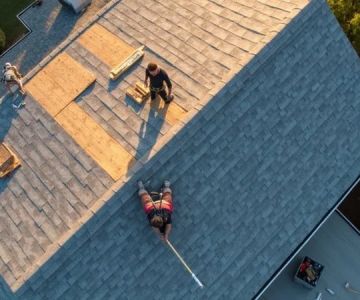


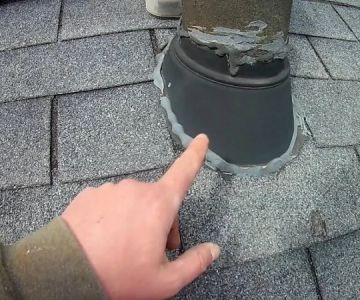

 Power Roofing Queens Village5.0 (9 reviews)
 B&B ROOFING & GUTTERS.5.0 (218 reviews)
 BP Builders | Roofer, Roof Replacement, Roofing Company & General Contractor4.0 (215 reviews)
 United roofing and concrete1.0 (7 reviews)
 Mike Gorman Roofing Inc.4.0 (14 reviews)
 Bonner Master Roofing5.0 (123 reviews)
 Roof Wind Uplift Ratings Explained for Hurricane Zone Safety
 How to Choose a Roofing Contractor That Uses Drones for Inspection and Estimates
 How to Install Roof Heat Cable on a Metal Roof to Prevent Ice
 What is a Roof Deck and How to Repair or Reinforce It
 How to Install Roof Flashing on a Roof with Unconventional Shapes and Angles
 How to Choose a Roofing Contractor That Provides References from Past Clients