
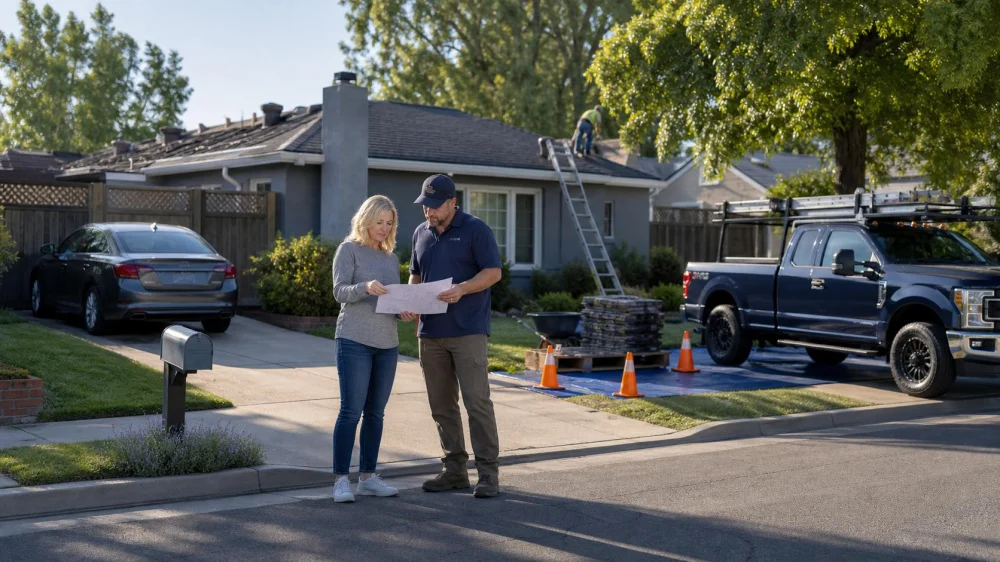
Roofing Crew Parking Plan: Keep Workday Access Clear
Table of contents
Quick answer
Before roofing starts, agree in writing where the crew truck, delivery vehicle, dumpster, trailer, homeowner cars, and material zone will go. Preserve a usable household exit and keep sidewalks, hydrants, mailboxes, gates, neighboring driveways, and emergency routes clear. Check local parking and permit rules instead of guessing. Share one simple map with the project manager and review it again each morning.

Premier Building Associates
North BranfordSouth Central Connecticut Planning RegionConnecticut
100 Shaw Rd, North Branford, CT 06471, USA
Make a simple site map
Sketch the property from above or mark a satellite image. Include the driveway width, garage doors, curb, sidewalk, gates, fences, mailbox, utility covers, overhead branches or wires, landscaping, and the route to each exterior door. Add the planned dumpster and material placement from the contract.
Use distinct zones for contractor vehicles, delivery unloading, homeowner parking, waste, and “keep clear.” The map does not need engineering precision; it needs enough detail for a driver arriving before the homeowner is outside. Date the version and send it to the contractor's designated project manager.
Build Pros Roofing and Siding in Albany
1706 Central Ave, Albany, NY 12205, USA
Ask what the contractor must position
A roofing operation may use more than passenger vehicles. Ask about:
- crew trucks and the approximate number of worker vehicles;
- material delivery trucks, conveyors, cranes, or forklifts;
- dump trailers, dumpsters, portable toilets, and equipment trailers;
- ladder access and clear drop or debris-control zones; and
- arrival times, repeat deliveries, and end-of-day storage.
Let the contractor determine equipment operating space and worker safety zones. A truck may require room to turn, deploy outriggers, raise a conveyor, or leave without backing through people. Do not promise a tight location solely because a vehicle physically fits when parked.
Protect household entry and exit
Move cars needed during the day before the first truck arrives. Choose a location beyond the debris and delivery area, and keep keys accessible. If a resident has mobility, medical, childcare, or work needs, identify the entrance that must remain usable and tell the project manager.
A clear garage door is not enough if a truck blocks the driveway apron. Trace the full path from parking space to street. Plan for school pickup, appointments, home-care visits, and deliveries. Reschedule nonessential service calls so plumbers, landscapers, and couriers do not enter an active roofing site unexpectedly.
Keep public and emergency access open
Do not block a neighbor's driveway, accessible curb ramp, sidewalk, crosswalk, fire lane, or hydrant. Required clearance distances and parking restrictions are local, so read signs and contact the appropriate municipal office when uncertain. Cones placed by a contractor do not create legal permission to reserve a public street.
Keep the address visible for emergency responders. Tell the project manager where utility shutoffs and covers are located, and avoid placing a vehicle or pallet over them. Maintain the access route identified for emergency use even when it is not the most convenient crew shortcut.
Check parking permissions in advance
Contact the city, county, township, parking authority, or public-works office about temporary restrictions, right-of-way permits, dumpster permits, street sweeping, snow routes, and residential parking zones. Ask the contractor who obtains and posts any required permit. Save the written answer.
Also check homeowner-association or private-road rules, but remember that private approval does not override public law. If neighbors share a driveway or access easement, review the recorded arrangement and coordinate early. Do not assume a verbal “it should be fine” settles a property right.
Confirm the plan on workday
- Move household vehicles and unlock the agreed gate before crew arrival.
- Walk the ground-level access route with the project manager.
- Identify keep-clear zones, fragile surfaces, irrigation, and utility covers.
- Confirm which person can authorize a vehicle or equipment change.
- Photograph the driveway, curb, lawn edges, gate, and parked arrangement.
- Review changes after deliveries, weather delays, or crew-size adjustments.
If an unfamiliar vehicle arrives, direct the driver to the project manager rather than waving it into a guessed space. Keep children and pets inside or securely away while vehicles are moving.
Parking and access checklist
- A dated site map shows vehicle, delivery, waste, and keep-clear zones.
- The contractor has stated truck, trailer, and equipment needs.
- Household vehicles needed during the day can reach the street.
- An appropriate entrance remains accessible for residents and planned care.
- Sidewalks, curb ramps, hydrants, mailboxes, and neighboring drives are clear.
- Local permits, signs, HOA rules, and street schedules are checked.
- Utilities, fragile paving, gates, and irrigation are documented.
- One project manager controls parking changes.
Limits and safety cautions
This article provides general homeowner planning information, not legal, traffic-engineering, or construction-safety advice. Parking laws, permits, easements, emergency clearances, mail service, accessibility requirements, and HOA rules vary. Confirm the current rule with the authority that enforces it.
Homeowners should not direct crane, conveyor, forklift, dumpster, ladder, or fall-protection operations. The contractor controls its workers, vehicles, and safety program. Stop and contact the project manager if a vehicle damages property, blocks a required route, leaks fluid, or creates an immediate hazard.
Frequently asked questions
Should the crew park in my driveway?
Only under the agreed plan. The driveway's condition, slope, capacity, household access, delivery method, and local rules all matter. Document existing damage first.
Can cones reserve spaces on a public street?
Not by themselves. Local authorization or a permit may be required. Ask the municipal parking or public-works office and follow posted restrictions.
What if I need to leave unexpectedly?
Tell the project manager before vehicles or equipment move. Do not walk through an active unloading, debris, or backing zone to retrieve a blocked car.
Who handles a parking ticket or towing charge?
Responsibility depends on the facts and contract. Prevent the issue by assigning permit duties and approved spaces in writing, then address any charge through the contracting parties rather than assuming.
Sources to verify
- USA.gov: Find Local Government Offices
- Your city or county parking, public-works, fire, building, and right-of-way offices for current public-street rules.
- Your signed roofing contract, approved site plan, permits, and the contractor's written logistics plan.
- Recorded easement documents and current HOA or private-road rules when shared access is involved.
Conclusion and next steps
Parking is part of the roof project, not an arrival-day improvisation. Map the property, learn what equipment needs, protect the household exit and public routes, verify permissions, and give one person authority to coordinate changes. A clear plan helps the crew start efficiently without trapping a car or creating a neighborhood conflict.




 Power Roofing Queens Village5.0 (9 reviews)
 B&B ROOFING & GUTTERS.5.0 (218 reviews)
 BP Builders | Roofer, Roof Replacement, Roofing Company & General Contractor4.0 (215 reviews)
 United roofing and concrete1.0 (7 reviews)
 Mike Gorman Roofing Inc.4.0 (14 reviews)
 Bonner Master Roofing5.0 (123 reviews)
 Roof Wind Uplift Ratings Explained for Hurricane Zone Safety
 How to Choose a Roofing Contractor That Uses Drones for Inspection and Estimates
 How to Install Roof Heat Cable on a Metal Roof to Prevent Ice
 What is a Roof Deck and How to Repair or Reinforce It
 How to Install Roof Flashing on a Roof with Unconventional Shapes and Angles
 How to Choose a Roofing Contractor That Provides References from Past Clients