
Roof Repair Change Orders: Pause, Price, and Sign the Scope
Roof work can uncover conditions that were hidden before shingles, flashing, or decking came off. Some changes are legitimate, but a verbal “we found more damage” does not tell a homeowner enough to approve cost, materials, timing, or responsibility. A written change-order process keeps the original repair, the new finding, and the revised agreement distinct.
Quick answer
When a roofer proposes extra work, pause before authorizing it. Compare the request with the signed contract, ask for dated photos and a plain-language explanation, and obtain a written change order that identifies added and removed work, exact materials, price, payment timing, schedule effects, permits, warranty treatment, and who approves it. Check state and local contract rules. Both parties should sign before changed work begins, except for narrowly defined emergency protection that you separately document.
Maynard Roofing /40 yrs Family Business
TauntonBristol CountyMassachusetts
45 Railroad Ave, Taunton, MA 02780, USA
Start with the signed contract
Read the original scope, allowances, exclusions, unit prices, concealed-condition clause, payment schedule, and change-order procedure. The contractor may already have priced items such as decking replacement per sheet or linear-foot fascia repair. Do not pay twice for work already included.
Identify the exact contract section affected. Is the proposal replacing an allowance, adding quantity, substituting a product, correcting a hidden defect, or changing the homeowner’s selection? Each has a different reason and documentation trail.
State law varies. Some jurisdictions require particular home-improvement terms, cancellation notices, license information, or signed written changes. Use the licensing board, consumer-protection office, permit authority, or an attorney for local requirements.

Paramount Exteriors LLC
StrasburgLancaster CountyPennsylvania
911 Eisenberger Rd, Strasburg, PA 17579, USA
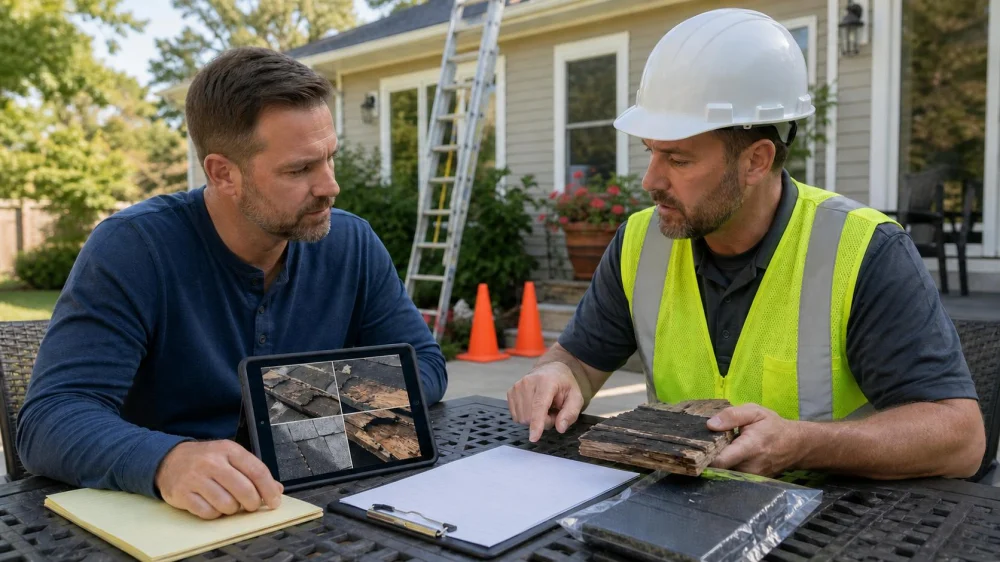
Ask for evidence of the new condition
Request overview and close-up photos showing location and scale before altered materials are removed when practical. The contractor should explain what was expected, what was found, why the condition matters, and what could happen if it is not corrected.
Ask whether the condition was visible or reasonably inferable during the estimate. Hidden rot beneath intact roofing differs from a missing item that should have been in the original visible scope. A second professional opinion may be appropriate for a large or disputed change, provided the roof can remain protected.
Do not climb onto the roof to inspect. Review evidence from the ground or interior and use qualified professionals. Preserve samples only when safe, useful, and agreed in writing.
Define the changed scope
A useful change order describes both additions and deletions. It should identify roof area, measurements or quantities, removal, substrate preparation, product manufacturer and line, material type, color where relevant, fastening or installation standard, flashing details, ventilation effects, disposal, and final cleanup.
If the full quantity is unknown, use a clear unit price and a method for documenting actual units. Define who verifies the count and whether there is a not-to-exceed amount or a second approval threshold.
Confirm whether the change affects code compliance, permits, inspections, structural review, manufacturer instructions, or another trade such as carpentry, masonry, solar, HVAC, or gutters. Avoid language such as “repair as needed” without boundaries.
Review price and payment effects
Ask for labor, material, equipment, permit, disposal, tax, overhead, and other components as appropriate. The format may vary, but the total and calculation should be understandable. Confirm whether credits are issued for work or materials removed from the original scope.
Link payment to an observable milestone, not merely to signature. Update the running contract total and remaining balance. Keep proof of payment and avoid methods that eliminate reasonable records or dispute protections.
Mechanics-lien rules, deposits, progress payments, and releases vary widely. Do not apply another state’s percentage limits to your project. Consult the relevant state licensing or consumer agency.
Update timing and protection
The change order should state added or reduced days, material lead time, inspection dependencies, and the revised completion target. Ask whether the roof will remain open while a decision or product is pending and how the building will be protected.
Record responsibility for temporary covering, water intrusion, interior monitoring, debris, and after-hours contacts. Weather can force a safe pause, but “weather delay” should not hide unrelated scheduling changes.
Tell occupants and neighbors about meaningful changes to noise, driveway use, delivery, or access. Reschedule other trades only after the revised sequence is confirmed.
Keep insurance roles separate
A contractor can document damage and provide a repair proposal, but coverage decisions belong to the insurer under the policy. Do not sign over claim authority or accept legal or adjusting advice from someone not authorized to provide it in your state.
Send requested documentation through the insurer’s official channel and keep the claim number, adjuster communications, estimates, and change order together. Approval by an insurer does not replace your contract review, and contractor approval does not guarantee insurance payment.
Be wary of a proposal that changes price solely to absorb the deductible or promises “free” work. Ask the insurer or state regulator about suspicious practices.
Handle urgent weather protection
An exposed roof may need immediate temporary protection before a full change can be evaluated. Define in writing, even by a time-stamped message, the emergency action, maximum authorized amount, location, material, and whether it is temporary. Request photos before and after.
Emergency stabilization should not become blanket approval for unrelated permanent work. Once the building is protected, return to the normal written process. Never climb onto a wet, storm-damaged, icy, or unstable roof to help.
Call emergency services for a collapse, electrical hazard, fire, gas odor, or immediate danger. Keep people away from sagging ceilings and active leaks near electrical equipment.
Frequently asked questions
Can I approve a change by text message?
Electronic signatures may be valid, but requirements vary. Use the contract’s process and a complete document that both parties retain.
What if the contractor already did the extra work?
Document what happened, review the contract and local law, and do not sign inaccurate paperwork. Seek consumer or legal advice if disputed.
Should a change order include a credit?
Yes, when original work or materials are deleted or replaced and the contract calls for a credit.
Can I refuse necessary code work?
Required work may be unavoidable, but you can still request documentation, pricing, permit details, and written authorization.
Next steps
Create a one-page checklist for every proposed change: contract reference, evidence, scope, materials, quantity, price, credit, payment, schedule, permit, protection, warranty, and signatures. Keep the signed change with the contract and final project records.
For an example of consumer guidance, see the California Contractors State License Board’s home improvement contract overview, then verify the rules in your own state.




 Strober-Wright Roofing Inc4.0 (9 reviews)
 John Roofing LLC1.0 (1 reviews)
 Clean Cut Construction5.0 (5 reviews)
 Weaver Roofing0.0 (0 reviews)
 Revival Home Improvements4.0 (21 reviews)
 Maspeth Contracting Corp. dba Maspeth Roofing & Siding4.0 (11 reviews)
 : How to Identify Roof Hail Damage: Size and Impact Markers - BeachCo Roofing Hub
 Final Roof Inspection Checklist Before Final Payment
 Are DIY Roof Repairs Actually Cheaper? Hidden Costs Explained
 How to Repair a Roof Leak in a Building with a Fabric Membrane Roof
 How to Prevent Roof Shingles from Blowing Off in High Winds
 The Cost of a New Roof with an Energy Star Rated Reflective Coating