
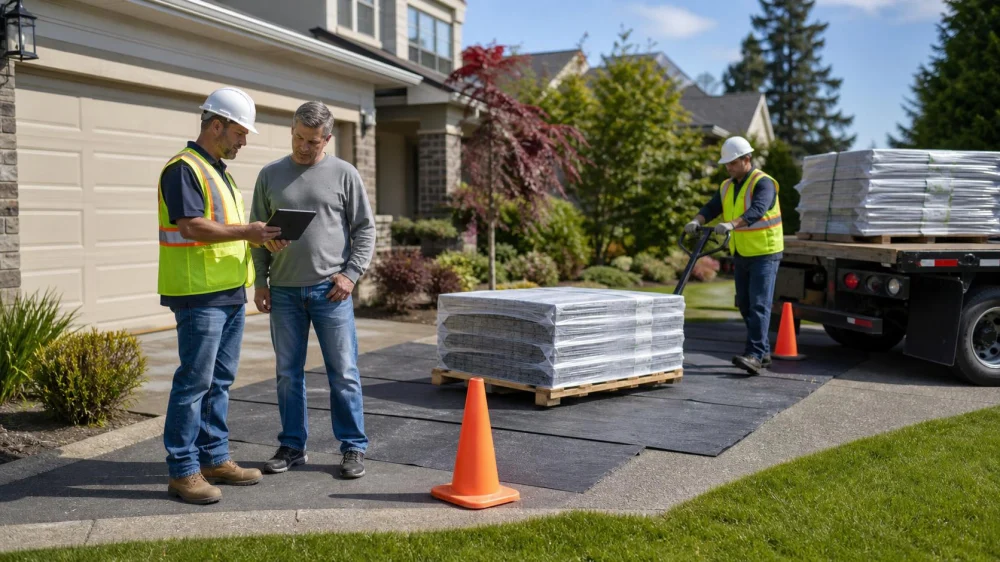
Roofing Material Delivery: Protect Access and Property
Roof repairs often begin before the crew climbs a ladder. Shingles, underlayment, flashing, lumber, fasteners, a dumpster, and lifting equipment may arrive in separate vehicles. A delivery plan protects people, driveways, landscaping, utilities, materials, and emergency access while making sure the contractor receives the correct products.
Quick answer
Before delivery, obtain the date window, vehicle type, load size, staging location, rooftop-loading plan, and responsible contact. Mark private utilities and fragile surfaces, move vehicles and movable property, preserve fire and medical access, and keep children and pets indoors. The contractor—not the homeowner—should direct unloading and verify products. Photograph conditions before and after, keep materials dry and secure, and document shortages, wrong products, or property damage immediately.

Confirm the delivery plan
Ask whether materials will arrive from the contractor, a distributor, a rental company, or several vendors. Record the expected day and time window, driver contact process, truck type, forklift or conveyor use, dumpster placement, and whether anyone must be present.
Confirm who has authority to accept, reject, and sign for products. A homeowner should not certify quantities or condition on the contractor’s behalf unless the contract explicitly assigns that role and the homeowner can verify it.
Review permit, homeowners-association, parking, curb-use, street-closure, and noise restrictions. Delivery arrangements must not block a public sidewalk, hydrant, neighboring driveway, mail access, waste pickup, or emergency route without proper authorization.

Saunders & Sons Roofing
SouthbridgeWorcester CountyMassachusetts
394 Elm St, Southbridge, MA 01550, USA
Map vehicle and pedestrian access
Walk the proposed route from the street with the contractor from ground level. Note narrow gates, low branches, overhead service lines, septic areas, drainage structures, soft shoulders, slopes, retaining walls, and tight turns. Do not rely on a satellite image alone.
Move household vehicles before the truck arrives and keep keys available for any vehicle that remains nearby. Establish a separate pedestrian path for occupants. Tell delivery staff about mobility needs or scheduled home services.
Keep people out of the unloading and lifting zone. Never walk under a conveyor, boom, raised pallet, or suspended load. Drivers and trained workers control their equipment; homeowners should not guide machinery unless specifically qualified and assigned.
Protect driveways and landscaping
Heavy vehicles, stabilizers, dumpster wheels, and pallets can crack or stain some driveways and compact soil. Ask the contractor to assess surface capacity and specify protective boards, mats, wheel paths, and dumpster pads. Improvised thin plywood may not distribute the load adequately.
Photograph the driveway, curb, walkway, siding, garage door, fences, trees, irrigation, and planting beds before delivery. Mark private sprinkler heads, invisible-fence wiring, septic components, landscape lighting, and other features that public utility marking may not cover.
Do not prune trees, move utility wires, or dismantle a fence solely on a driver’s request. Pause and contact the contractor if the planned access is not workable.
Approve material placement
Ground-staged materials need a flat, stable, secure location that preserves drainage and access. Keep pallets away from retaining-wall edges, soft soil, slopes, ignition sources, and areas where children or pets could climb them. Do not stack products against siding or doors.
Rooftop loading requires professional evaluation and controlled placement. Concentrated bundles can overload a roof area, slide, damage finished surfaces, or block work. The contractor should decide whether rooftop delivery is appropriate and coordinate the distributor; a homeowner should never move bundles onto or across a roof.
Maintain clear paths to electrical panels, gas shutoffs, exits, fire equipment, and utility meters. Confirm where removed material and new material will be separated.
Verify products without handling them
The contractor should compare the delivery with the approved scope: manufacturer, product line, profile, color or blend, rating, lot or batch information where relevant, quantity, flashing metal, underlayment, ventilation components, fasteners, and accessories.
Homeowners can photograph visible package ends and labels for the project file without opening bundles or climbing. A matching color name does not always mean the same production lot or product specification.
Do not allow an unapproved substitution because the truck is waiting. If something differs, isolate it, contact the contractor, and use the written change process. Installation can make later identification and return difficult.
Protect materials from weather
Follow manufacturer storage instructions. Some products must remain dry, upright, shaded, ventilated, supported off the ground, or within a temperature range. Factory wrapping may be designed for transport rather than prolonged outdoor storage.
Secure lightweight sheet goods, packaging, and accessories against wind without crushing or trapping moisture. Do not create a tarp arrangement that channels water toward the house or becomes airborne.
If severe weather is forecast, ask whether delivery should be rescheduled. Wet, snow-covered, or wind-exposed rooftop loading can create additional hazards. Never climb up to cover materials yourself.
Document damage or a wrong delivery
Keep everyone safe first and do not confront a moving vehicle. Photograph the overall scene and details from a safe ground location. Record date, time, company, vehicle identification, people notified, and observable condition.
Report a shortage, wrong product, torn packaging, wet material, or property damage to the contractor promptly in writing. Do not sign a delivery document stating that everything is correct if you cannot verify it; note exceptions according to the delivery company’s process.
For a fuel or hydraulic leak, keep people away, avoid ignition, and contact the responsible company and local emergency or environmental authority as appropriate. Do not wash fluids into a storm drain.
Frequently asked questions
Do I need to be home for delivery?
Ask the contractor. A responsible project representative should be available to direct placement and handle discrepancies.
Can shingles be placed on the roof before work?
Only when the contractor and delivery professionals determine the roof, load distribution, weather, and work plan make it appropriate.
Who checks the product color?
Define responsibility in advance. The contractor should verify the approved product, while the homeowner may also confirm the selection before installation.
Should I let the truck use my lawn?
Not without a reviewed access plan. Soil, irrigation, septic systems, and buried private features may be damaged.
Next steps
Ask for a delivery map and contact list before materials are dispatched. Photograph the property, move vehicles, mark private features, preserve emergency access, and keep the unloading zone clear. Have the contractor verify every product and document the site again after the truck leaves.





 Strober-Wright Roofing Inc4.0 (9 reviews)
 John Roofing LLC1.0 (1 reviews)
 Clean Cut Construction5.0 (5 reviews)
 Weaver Roofing0.0 (0 reviews)
 Revival Home Improvements4.0 (21 reviews)
 Maspeth Contracting Corp. dba Maspeth Roofing & Siding4.0 (11 reviews)
 : How to Identify Roof Hail Damage: Size and Impact Markers - BeachCo Roofing Hub
 Final Roof Inspection Checklist Before Final Payment
 Are DIY Roof Repairs Actually Cheaper? Hidden Costs Explained
 How to Repair a Roof Leak in a Building with a Fabric Membrane Roof
 How to Prevent Roof Shingles from Blowing Off in High Winds
 The Cost of a New Roof with an Energy Star Rated Reflective Coating