
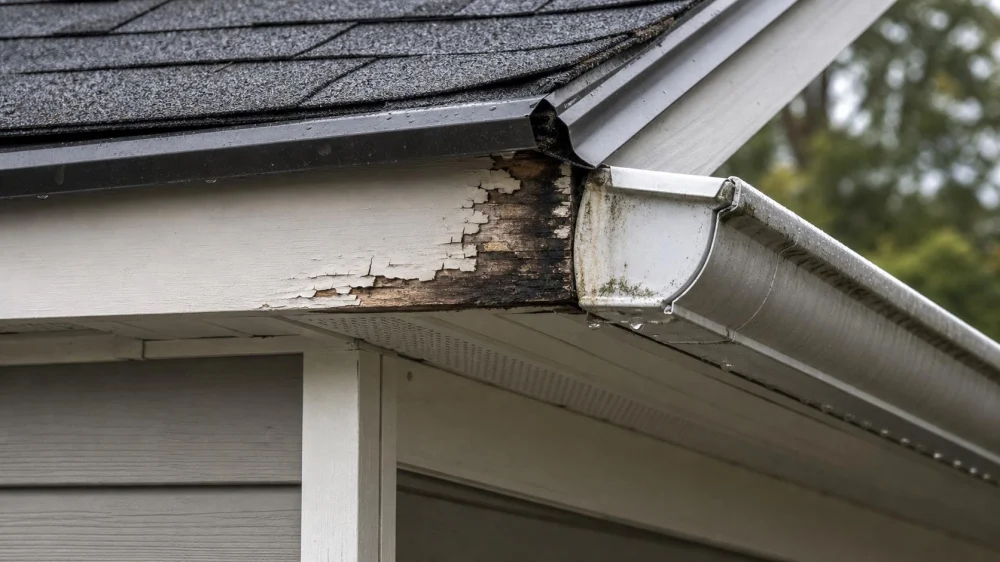
Why Fascia Boards Rot Near Roof Edges
On this page
- Quick answer
- What fascia does at the roof edge
- Common reasons fascia stays wet
- Signs visible from safe locations
- How a contractor should trace the source
- What a complete repair may include
- Reduce the chance of repeat damage
- Unsafe or incomplete fixes to avoid
- Frequently asked questions
- Conclusion and next steps
Quick answer
Fascia boards rot when roof-edge details repeatedly direct or hold water against wood. Common sources include overflowing or mispitched gutters, failed drip edge, short shingles, leaking gutter fasteners, open joints, damaged roof-edge flashing, and water traveling from above. Peeling paint is a warning, not the cause. Diagnose and correct the water path before replacing or covering the board.
What fascia does at the roof edge
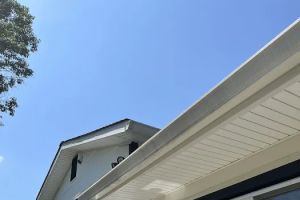
Fascia is the finished vertical surface at many roof eaves and rakes. It may support gutter attachment, cover rafter or truss ends, and help close the roof edge. Materials include solid wood, engineered wood, fiber cement, metal-wrapped wood, PVC, and other products.
Fascia works with shingles or roof membrane, roof deck, drip edge, underlayment, gutters, soffit, and ventilation. Damage at the visible board may originate elsewhere in that assembly.
Common reasons fascia stays wet
- Gutter overflow: Debris, undersized drainage, blocked outlets, or heavy rainfall sends water over the back or front edge.
- Incorrect gutter slope or position: Water ponds, misses the gutter, or runs behind it.
- Drip-edge problems: Missing, damaged, poorly lapped, or incorrectly positioned metal may fail to direct water into the gutter.
- Roof-covering edge defects: Short, lifted, cracked, or deteriorated shingles can expose the edge assembly.
- Fastener leaks: Gutter spikes, screws, brackets, and other penetrations can admit water.
- Open joints and failed coatings: End grain and joints absorb repeated moisture when detailing or maintenance fails.
- Ice and snow effects: Freeze-thaw cycles and ice buildup can redirect water in cold climates.
- Upper-roof drainage: Valleys, sidewalls, dormers, or downspouts can concentrate more water at one section.
Condensation and poor attic ventilation can sometimes wet the eave from behind. A professional should distinguish exterior runoff from moisture originating inside the roof assembly.
Signs visible from safe locations
Inspect from the ground, an interior window, or another stable location without climbing. Binoculars and a zoom camera can help document:
- Peeling, blistered, or darkened paint
- Swollen edges, open seams, or sagging sections
- Gutters pulling away from the roofline
- Water running behind the gutter during rain
- Staining on soffit panels or exterior walls
- Localized algae, mold-like growth, or insect activity
- Soft-looking or missing material near fasteners
From the attic, only where access is safe, look for staining or dampness near the eave. Do not step between framing members or disturb insulation, wiring, wildlife, or suspected hazardous material.
How a contractor should trace the source
A qualified roofer, gutter contractor, or exterior carpenter should inspect the assembly rather than quoting a cosmetic cover from photographs alone. Ask the contractor to document:
- The full length and depth of damaged fascia
- Condition of the gutter, hangers, outlets, and downspouts
- Roof-covering overhang and drip-edge configuration
- Deck, rafter-tail, subfascia, and soffit condition
- Water entry from valleys, walls, penetrations, or upper drainage
- Ventilation and interior moisture where relevant
- Whether insects are a cause, result, or separate problem
A controlled water test may help, but it should be planned by an experienced professional who can isolate one area at a time without flooding the building.
What a complete repair may include
The scope depends on material and hidden damage. It may include temporary weather protection, gutter removal, replacement of deteriorated fascia or subfascia, repair of deck or framing, correct roof-edge metal, roof-covering repair, joint and coating details, and gutter reinstallation with suitable slope and fastening.
Ask whether the proposal includes:
- Removal versus covering of damaged material
- Matching material, thickness, profile, and finish
- Hidden-damage unit prices or approval process
- Gutter and downspout work
- Drip-edge and roof-covering integration
- Ventilation openings and insect screening
- Cleanup, warranty, permits, and final photographs
Metal wrapping can protect sound wood when correctly detailed, but wrapping rotten or wet wood conceals damage and leaves fasteners without a reliable base.
Reduce the chance of repeat damage
- Have gutters and outlets inspected and cleaned at intervals suited to local trees and weather.
- Watch the roof edge during ordinary rain from a safe indoor or ground location.
- Direct downspouts away from foundations and lower roof sections as designed.
- Maintain coatings and joints according to the fascia manufacturer.
- Address loose gutters, missing metal, and roof-covering damage promptly.
- Keep records and photographs of repairs for future comparison.
Do not pressure-wash roof edges or gutters from a ladder. High-pressure water can force moisture into assemblies and damage finishes.
Unsafe or incomplete fixes to avoid
- Painting soft or wet wood without fixing the source
- Sealing every gap and accidentally blocking intended drainage or ventilation
- Nailing new material over decay
- Rehanging a heavy gutter on damaged fascia
- Walking the roof or leaning a ladder against a weak gutter
- Working near overhead power lines
- Assuming one visible spot represents the full extent of damage
Frequently asked questions
Can rotten fascia cause a roof leak?
Fascia rot and interior leakage can share the same water source. Deterioration can also expose adjacent components. A roof-edge inspection is needed.
Should gutters be replaced with the fascia?
Not always, but gutters often must be removed for access. Reuse depends on condition, capacity, configuration, and whether they contributed to damage.
Can PVC fascia solve the problem permanently?
Moisture-resistant material does not correct defective drainage, flashing, roof deck, framing, or fasteners. The water path still must be fixed.
Why is damage worst at corners?
Gutter joints, miters, downspout outlets, roof valleys, and end-grain joints can concentrate leakage at corners. Inspection should trace the exact route.
Is fascia damage an emergency?
Urgency rises with active water entry, a detached gutter, falling material, electrical exposure, or structural deterioration. Keep people away and call an appropriate contractor.
Conclusion and next steps
Rot at the roof edge is evidence of repeated moisture. Document stains and gutter behavior from a safe location, protect people from loose material, and ask a qualified contractor to trace the water path through the complete eave assembly. Repair the source and hidden damage before replacing, painting, or wrapping fascia.

 Semper Roofing Ellicott City4.0 (75 reviews)
 SKYLINE ROOFING & SIDING SERVICES INC5.0 (16 reviews)
 Novak Home Improvements Co.4.0 (53 reviews)
 Emerald Roofing and Siding LLC5.0 (243 reviews)
 The USA Roofer5.0 (31 reviews)
 L&M Company4.0 (6 reviews)
 The Average Cost of a Roof Coating Application
 Moss and Algae on Roof: Safe Removal Techniques and Prevention Tips
 Battery Storage Integration with Roof Solar Systems Explained
 How to Install Roof Ice and Water Shield on Complex Roof Details
 How to Choose a Roof Ventilator: Static, Powered, Turbine, or Ridge?
 Cedar Shake Roof Maintenance: Cleaning, Treating, and Repairing Wood Shakes