
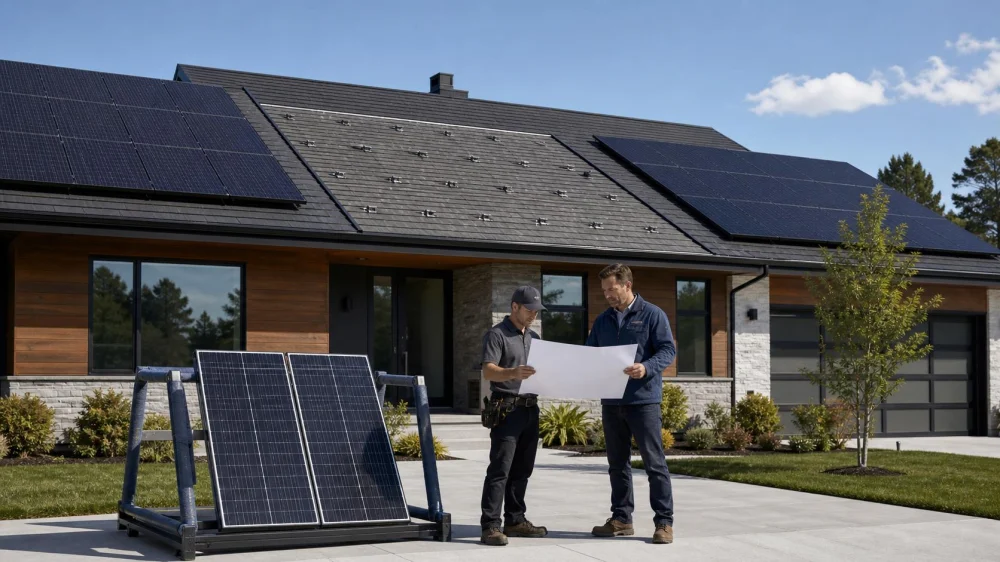
Roof Repair With Solar Panels: Coordinate Removal and Reinstall
On this page
- Quick answer
- Confirm ownership, contract, and authority
- Assign the solar and roofing scopes
- Treat the array as energized equipment
- Document the system before removal
- Coordinate deck, roofing, and mounts
- Require a controlled reinstall and inspection
- Close warranty and responsibility gaps
- Solar roof-repair checklist
- Frequently asked questions
- Sources and evidence notes
- Conclusion and next steps
Quick answer
Roof work beneath a photovoltaic array usually requires planned removal and reinstall by qualified solar and electrical professionals, coordinated with the roofing contractor. Confirm who owns the system, who may authorize work, how equipment will be de-energized and stored, which roof areas will be opened, and who restores mounting, wiring, permits, inspections, monitoring, and warranties.
Do not unplug connectors, remove panels, walk under suspended modules, or assume a shutoff makes sunlit panels harmless. Keep homeowners and unqualified roof workers out of electrical and solar-equipment tasks.
Legacy Built Exteriors ,LLC
BowiePrince George's CountyMaryland
16701 Melford Blvd, Bowie, MD 20715, USA
Confirm ownership, contract, and authority
Find the purchase agreement, lease, power purchase agreement, financing documents, installer warranty, roof warranty, monitoring contract, utility interconnection record, permits, and system plans. A leased or third-party-owned system may require the owner’s approved contractor and written authorization before removal.
Ask about removal and reinstall fees, scheduling, storage, damage responsibility, production guarantees, roof penetrations, insurance, and whether contract changes or lender consent are needed. Do not let emergency scheduling bypass ownership rights.

Assign the solar and roofing scopes
Name one coordinator and create a written sequence. The solar contractor handles system shutdown procedures, electrical disconnects, module and racking removal, equipment records, reinstall, testing, and monitoring. The roofer handles safe roof access, covering removal, deck and flashing repair, underlayment, new roofing, and roof warranty.
Some companies are qualified for both scopes; many are not. Verify licenses, insurance, certifications, manufacturer authorization, and permit responsibility for each trade. The U.S. Department of Energy recommends qualified professional solar installation and notes certified electrician inspection as part of the process.
Treat the array as energized equipment
Photovoltaic modules can produce electricity whenever exposed to light. System switches, rapid-shutdown equipment, inverters, batteries, and utility disconnects have specific procedures and limitations. Only trained and authorized personnel should isolate, test, label, disconnect, and reconnect equipment.
Do not cover panels with improvised tarps, cut conductors, separate connectors under load, or store modules where damaged wiring can contact people or water. Battery systems add separate stored-energy and fire-response requirements.
Document the system before removal
Record the module layout from safe locations, equipment model and serial numbers, racking, attachment points, flashing, conduit routes, roof penetrations, inverter and battery status, monitoring screen, and recent production baseline. Photograph existing damage and note nonworking components before anyone moves them.
Use a removal inventory with module location, condition, connector caps, hardware, storage rack, and custody. Protect glass, backsheets, wiring, and labels. Agree on who pays if testing finds pre-existing failure.
Coordinate deck, roofing, and mounts
The DOE advises homeowners to consider roof age before installing rooftop solar, and its replacement guidance says panels and mounting systems need removal for roof replacement. During repair, the roofer needs clear access to inspect decking, previous holes, underlayment, drainage, and all attachment locations.
Before new roofing is covered by panels, agree on mount layout, attachment engineering, flashing products, roof-manufacturer requirements, fire-setback pathways, and any abandoned-hole repair. Do not reinstall into damaged decking or reuse parts that the manufacturer prohibits from reusing.
Require a controlled reinstall and inspection
Reinstall according to approved plans, current manufacturer instructions, structural requirements, and local building, fire, and electrical codes. Confirm attachment torque, flashing integration, wire support, connector compatibility, grounding or bonding, array spacing, rapid shutdown, labels, and weather sealing through qualified inspection.
After authorization to energize, compare monitoring and production with the recorded baseline under comparable conditions. Check that all strings, optimizers or microinverters report correctly and that alerts are resolved. Production can vary with weather, shade, season, and utility conditions, so investigate rather than promising an exact number.
Close warranty and responsibility gaps
Obtain separate written warranties for roof work, mounting and flashing, electrical labor, and solar equipment. Ask how one contractor’s work affects another manufacturer’s warranty and who responds if a leak appears beneath the array.
Keep final photos, permits, inspection approvals, updated plan, equipment inventory, shutdown and restart record, monitoring screenshots, invoices, and contact list. Confirm that the roofer can access warranty areas without violating the solar agreement.
Solar roof-repair checklist
- Identify system owner, contract, lender, and warranty.
- Use qualified solar, electrical, and roofing contractors.
- Create one written sequence and coordinator.
- Document layout, serials, condition, and production.
- Use authorized electrical shutdown and removal procedures.
- Store modules and hardware securely.
- Inspect deck and repair abandoned penetrations.
- Approve mount, flashing, and setback details.
- Complete permits, inspections, testing, and monitoring.
- Collect all warranties and final records.
Frequently asked questions
Can a roofer move one panel temporarily?
Only if the company is qualified and authorized for that system and follows electrical, product, and contract requirements.
Does turning off the inverter make panels safe?
Not necessarily. Sunlit modules can still produce electricity; trained personnel must apply the system procedure.
Who pays for removal and reinstall?
The purchase, lease, financing, warranty, insurance, and roofing contracts determine responsibility.
Can old mounting holes be filled with sealant?
The roof contractor should use a documented deck and roofing repair compatible with the assembly, not an unspecified surface patch.
Must permits be updated?
Requirements vary by jurisdiction and scope. Confirm building, electrical, fire, and utility steps before work.
How do I verify the array works afterward?
Use qualified electrical testing, inspection approvals, monitoring status, and comparison with the pre-work production record.
Sources and evidence notes
The Department of Energy’s Homeowner’s Guide to Solar advises considering roof age and using qualified professionals. DOE’s rooftop solar replacement guide states that roof replacement requires removal of panels and the mounting system.
DOE also provides an overview of rooftop solar permitting and inspection. The actual contracts, system instructions, plans, and local authorities govern the project.
Conclusion and next steps
Resolve ownership and authorization first, then coordinate qualified solar, electrical, and roofing scopes in one sequence. Preserve the system record, protect energized equipment, expose and repair the roof properly, and reinstall under approved details. Close the project only after inspection, monitoring, documentation, and warranties are complete.


 Hernandez & Sons Roofing4.0 (34 reviews)
 Miller & Sons Roofing & Remodeling4.0 (34 reviews)
 Colonial Remodeling LLC3.0 (6 reviews)
 Dream Home Roofers5.0 (245 reviews)
 EXTERIORS ASSOCIATES INC. Our 25th Year!0.0 (0 reviews)
 Alb Best Way Construction5.0 (66 reviews)
 How to Install Roof Flashing on a Roof with a Combination of Steep and Flat Sections
 How to Clean Solar Panels on a Roof Without Damaging Shingles or Voiding Warranties
 How to Choose a Roofing Contractor That Specializes in Complex Historic Restoration
 How to Choose a Roofing Material That Compliments Your Siding
 The Pros and Cons of a Modified Bitumen (Mod Bit) Roof
 Rubber Roofing for Flat Roofs EPDM vs TPO vs PVC Comparison Guide