
Roofing Dumpster Placement: A Homeowner Checklist
On this page
- Quick answer
- Let the contractor and hauler plan placement
- Map the property before delivery
- Protect the driveway and hardscape
- Locate utilities and underground systems
- Keep emergency and household access
- Separate the debris drop zone
- Plan for streets and neighbors
- Confirm accepted waste and disposal
- Verify delivery and pickup details
- Inspect after removal
- Important safety limits
- Placement checklist
- Frequently asked questions
- Evidence and sources
- Next steps
Quick answer
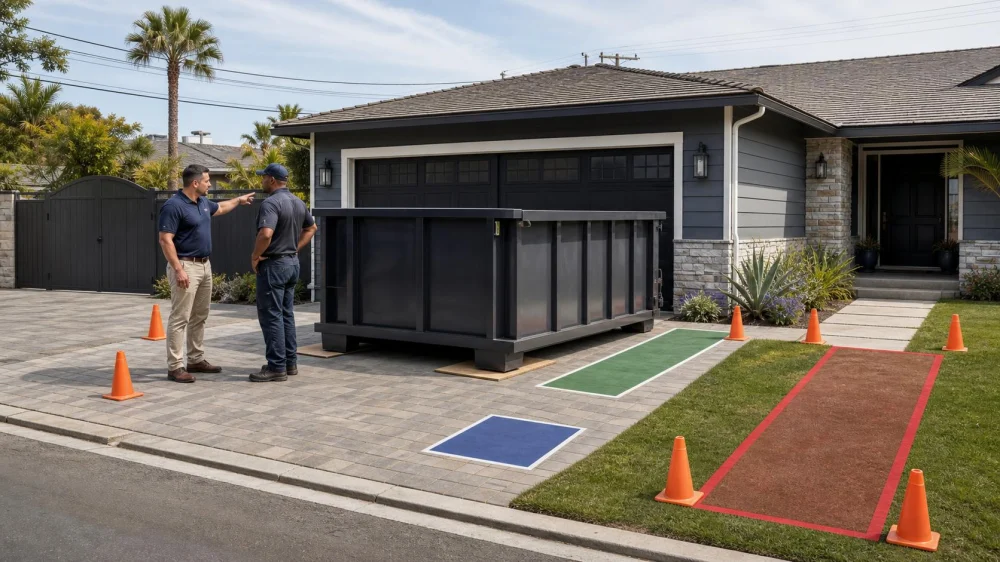
Before a roofing dumpster or debris trailer arrives, have the roofing contractor and hauler approve a placement plan. Confirm load size, truck clearance, driveway protection, property boundaries, overhead wires, underground utilities, septic components, irrigation, drainage, emergency access, local permits, and the protected debris route from roof to container.
Do not direct a heavy container onto a lawn, sidewalk, driveway, septic field, or public street based only on appearance. The contractor and hauler need accurate property information and must follow local rules. Keep people, pets, vehicles, and neighbors outside the loading and falling-debris zone.

Let the contractor and hauler plan placement
A loaded roofing container can be extremely heavy, and the delivery truck needs room to back, tilt, roll, or lift. The person who sold the roof may not be the driver who places the container, so request a written site plan shared with the roofing crew and waste hauler.
Ask who has final authority to reject a location. The driver may identify slope, soft ground, low wires, insufficient turning radius, or overhead branches that were not obvious in photographs. Have an alternate location ready.
Confirm who pays for permits, street occupancy, driveway damage, towing, extra pickup, overweight charges, prohibited material, and a failed delivery. These terms belong in the project scope, not a conversation after the truck arrives.

Map the property before delivery
Draw a simple plan showing the house, driveway, garage, gates, walkways, property line, street, alleys, trees, fences, air-conditioning equipment, fuel tanks, wells, septic area, drains, retaining walls, and overhead service lines.
Add the roof sections being removed and the intended debris path. Photograph the proposed area and nearby surfaces before delivery. Include measurements, but let the hauler verify them.
Mark items that are hidden from the road: a low eave, basketball hoop, buried drain, decorative paver edge, shallow irrigation pipe, invisible property pin, or gate that cannot open fully. Do not assume the driver can infer them.
Protect the driveway and hardscape
Ask whether the driveway material, thickness, age, slope, and condition can support the truck and loaded container. Asphalt softened by heat, cracked concrete, decorative pavers, and unsupported edges can require special precautions or a different location.
The contractor may propose wood blocking or protective boards under contact points. Only the hauler should approve how support is placed; an improvised board can shift or transfer load poorly. Clarify whether surface protection reduces risk or creates a contractual guarantee.
Move vehicles before delivery. A container can block the garage for days, and a truck may need the full driveway width at pickup. Protect landscaping from doors, swinging gates, wheels, and the crew’s walking path.
Record existing cracks, stains, settlement, and chipped edges with time-stamped photos. Take matching photos after removal.
Locate utilities and underground systems
Overhead electrical, communication, and tree-clearance hazards must be evaluated by professionals. Never estimate safe clearance or try to move a line. If the truck or raised container could approach a wire, choose another location and involve the utility when required.
Tell the contractor and hauler about buried gas, electric, water, sewer, drainage, irrigation, propane lines, and invisible easements. Use the required utility-locate process before any staking, anchoring, or ground disturbance.
Keep heavy vehicles and containers away from septic tanks, distribution boxes, drain fields, wells, cisterns, culverts, and unsupported covers. Obtain a system map or service-provider guidance rather than guessing from grass color.
A utility locate may not identify privately installed lines. Ask who is responsible for locating private irrigation, lighting, propane, or outbuilding service.
Keep emergency and household access
Maintain a safe route to the main entrance, an emergency exit, the electrical panel, gas shutoff, water shutoff, and equipment that may require service. The placement should not trap a vehicle needed for work, school, disability access, or medical care.
Do not block fire hydrants, mailboxes, sidewalks, accessible routes, shared drives, neighboring garages, or required sightlines. Local rules may specify exact clearance.
Arrange deliveries, home health visits, waste collection, and school pickup around roofing activity. Tell the contractor about anyone who cannot use an alternate stair or long route.
Separate the debris drop zone
The shortest path from roof to dumpster is not automatically safe. The contractor controls how materials are lowered or moved. OSHA construction rules address protected areas for falling debris and enclosed chutes in applicable work; homeowners should remain outside every barricaded zone.
Ask where tear-off material will travel and how the crew will protect windows, siding, doors, plants, air-conditioning units, and neighboring property. Never walk between the roof edge and container to retrieve mail or move a tool.
Keep children and pets indoors or off-site while tear-off and loading occur. Do not stand at a window immediately below the active roof area. Follow the site supervisor’s instructions if the zone changes.
At the end of each workday, ask how the container will be covered or secured and how loose debris will be controlled. Do not climb into the dumpster or compress material yourself.
Plan for streets and neighbors
A dumpster on a public street may require a permit, reflective markings, lighting, restricted hours, or placement by an approved hauler. Contact the local authority or make the contractor responsible in writing.
Confirm street-sweeping, trash-day, snow-route, fire-lane, and parking restrictions. Leave enough sight distance at driveways and intersections. Do not reserve public space with household objects.
Notify neighbors who share a drive or whose vehicle access may be affected. Provide the contractor’s site contact, not a promise that no inconvenience will occur.
Confirm accepted waste and disposal
Roofing debris can include asphalt shingles, underlayment, flashing, fasteners, wood, packaging, and damaged decking. Ask which materials may go in the container and which require separation.
EPA resources identify roofing as construction and demolition debris and encourage appropriate separation, recycling, and disposal. Local landfill and recycling rules control acceptance. Hazardous or suspected asbestos-containing material needs specialized assessment and handling.
Do not add household trash, paint, solvents, batteries, tires, appliances, propane cylinders, or another contractor’s waste. Prohibited material can delay pickup and create extra cost or risk.
Ask for the disposal or recycling facility, weight allowance, overage rate, and documentation available. Confirm whether old shingles will be recycled where a suitable program exists.
Verify delivery and pickup details
One business day before delivery, reconfirm container type, arrival window, exact marked location, driver contact procedure, permit, surface protection, alternate location, and who must be present.
Clear the route from the street to the placement area, including vehicles, low decorations, sports equipment, and unlocked gates. Do not trim a utility-owned tree or move a wire.
Before pickup, ensure the load is below the permitted fill line and contains no prohibited item. The crew, not the homeowner, should address protruding nails, unstable material, or an uncovered load.
Inspect after removal
Once the hauler leaves and the contractor releases the area, compare before-and-after photos. Check the driveway, curb, pavers, drainage, gate, plantings, and exterior equipment.
Ask the roofing crew to perform the contracted magnetic and visual cleanup, while recognizing that no magnet guarantees every fastener is found. Wear sturdy footwear and keep children and pets away until final cleanup is complete.
Report damage promptly with location-specific photos. Preserve receipts and written communications. Do not attempt structural driveway repair before responsibility and method are documented.
Important safety limits
This guide is general planning information. Container loads, vehicle access, fall protection, debris handling, utility clearance, permits, waste classification, and surface capacity require qualified contractors and local authorities.
Never enter a dumpster, stand under roofing work, guide a backing truck unless trained and assigned, approach overhead lines, or inspect a roof to improve the placement plan. Stop work and contact the appropriate professional if suspected asbestos, hazardous material, unstable structures, or damaged utilities appear.
Placement checklist
- Contractor and hauler approve primary and alternate sites.
- Property map includes wires, utilities, septic, drainage, and access.
- Driveway capacity and protection are confirmed.
- Permit and street rules are assigned.
- Emergency, disability, garage, and neighbor access remain open.
- Debris path and barricaded drop zone are defined.
- Accepted waste, weight, cover, and disposal site are documented.
- Before photos and pickup inspection are complete.
Frequently asked questions
Can a roofing dumpster sit on asphalt?
Sometimes, but asphalt condition, temperature, container supports, and load matter. The hauler and contractor must approve the site and protection.
Can it go on the lawn?
Soft soil, irrigation, septic systems, drainage, and restoration risk may make lawn placement unsuitable. Do not approve it without professional review.
Who obtains a street permit?
Responsibility varies by contract and municipality. Assign the task in writing and verify approval before delivery.
May I put my own trash in the container?
Not unless the contractor and hauler expressly allow the exact material. Weight and disposal rules are part of the roofing contract.
Evidence and sources
- OSHA: Construction debris chutes and protected areas
- EPA: Types of disaster and construction debris
- EPA: Construction and demolition waste considerations
Next steps
Ask the contractor for the container type and hauler requirements. Mark a primary and alternate location on a property sketch, then verify utilities, septic, permits, surface protection, and access.
Do not finalize placement until the hauler accepts it. Save the approved plan and before photos with the roofing contract.





 Skyfall Exteriors LLC4.0 (110 reviews)
 Ramsey Roofing Contractor Installation & Repair LLC5.0 (11 reviews)
 Black Stone Roofing, LLC5.0 (2 reviews)
 J Land Group • Contracting & Restoration5.0 (34 reviews)
 Goldman Roofing4.0 (10 reviews)
 Gem Roofing & Waterproofing4.0 (2 reviews)
 How to Install a Roof Saddle to Divert Water on a Flat Roof
 How to Install Roof Flashing on a Complex Roof with Multiple Pitches
 Roof Square Explained: What it is & Why It’s Important for Roofing Quotes
 Wasp Nests in Roof Vents Safe Removal Without Roof Damage
 How to Repair a Roof Leak in a Building with a Fabric Tensile Roof Structure
 Average Cost of Roof Coating for a Large Commercial Building